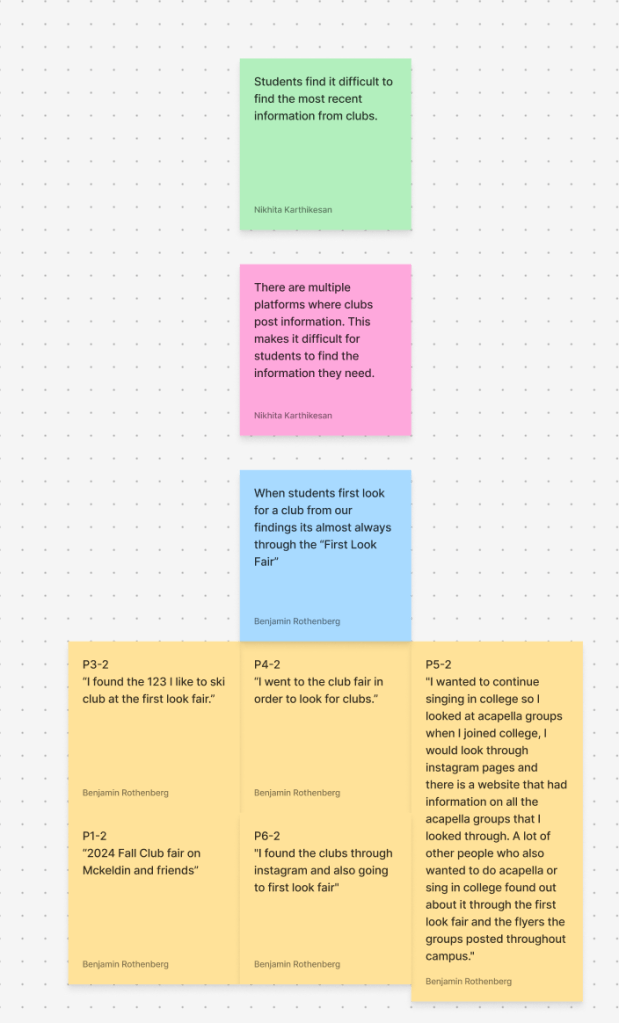
Our findings suggest that students at University of Maryland often depend heavily on the university itself to promote the “First Look Fair” as the main method to promote campus clubs and organizations. The first look fair has become an annual tradition and a key event for student engagement acting as both a social and information hub. However this dependency on the fair to promote clubs and organizations exposes the potential gap in the way information about these organizations is distributed.

From our interviews and survey response nearly all participants reported that they discovered their current club or organization through the FIrst Look Fair. Only a small number mentioned different ways of finding the club or organization. Often their method included peers or social media. This pattern suggests that while the fair does its job and is effective at it, it also limits the accessibility of information to a single point in time every year. Students who can’t attend or who transfer mid year may struggle to find the correct details about organization online.
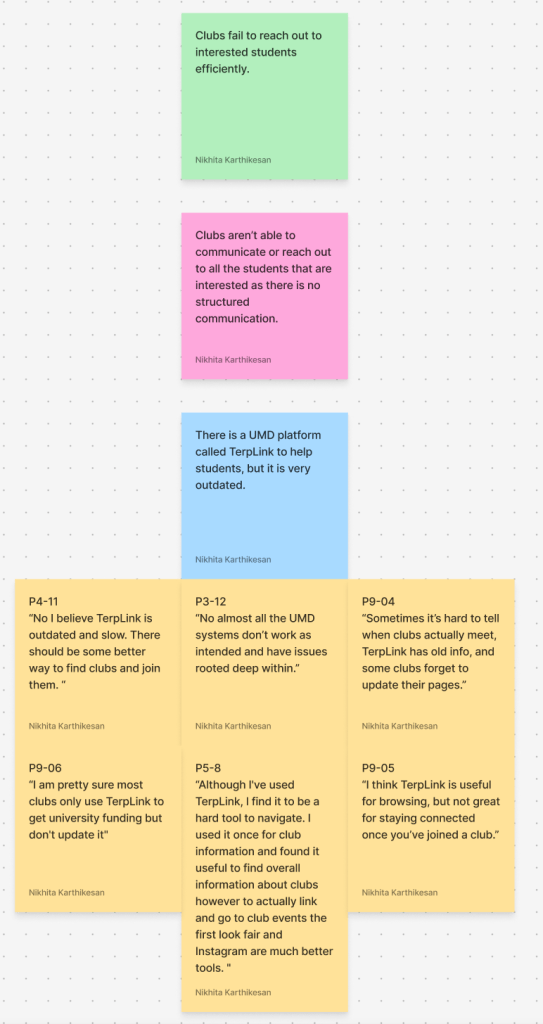
Our research revealed that most student clubs primarily communicate through private channels and social media platforms. This tends to limit their visibility to a broader student audience. Instagram was the most commonly cited platform for club communication but in many cases these accounts primarily reach to students who are already aware of or involved in the organization. This creates an internal communication loop where posts circulate among current members and their immediate friends, rather than attracting new students. The lack of broader outreach such as regular updates on TerpLink makes it difficult for interested students to discover new opportunities independently.
 INST362 Group 6 (302)
Leave a comment